Prolog
I recently gave an invited keynote at the AES convention, "Unreasonable Audio Innovation." We posted it on our web for you to enjoy. The writing process made me reflect on the state of our industry and how we work here at PURIFI and how it might be different. The result could be called a manifesto but since we are a big band and all love music it took the shape as a symphony in 4 movements.
Boundary Conditions
Before the symphony itself, the boundary conditions that made it possible. We realized early that our first product ideas had to change — we were chasing some of the real residual problems in audio, not a quick win. That takes a patient investor willing to take the long view, and we're grateful to Peter for that. It also took time — a lot of it — just walking the landscape of Zealand and Belgium, talking, before we had a product, a customer, or an employee to steal that time from us.
That's not a recipe I'd hand to every entrepreneur — it took longer and was harder than we expected. But we think we ended up with something that can carry PURIFI a long way.
First Movement: the Vision.
First movement: The vision. Imagine the product could simply be much better than what exists — no complacency, no comfort in the status quo. Have the nerve to win unconventionally rather than lose conventionally.
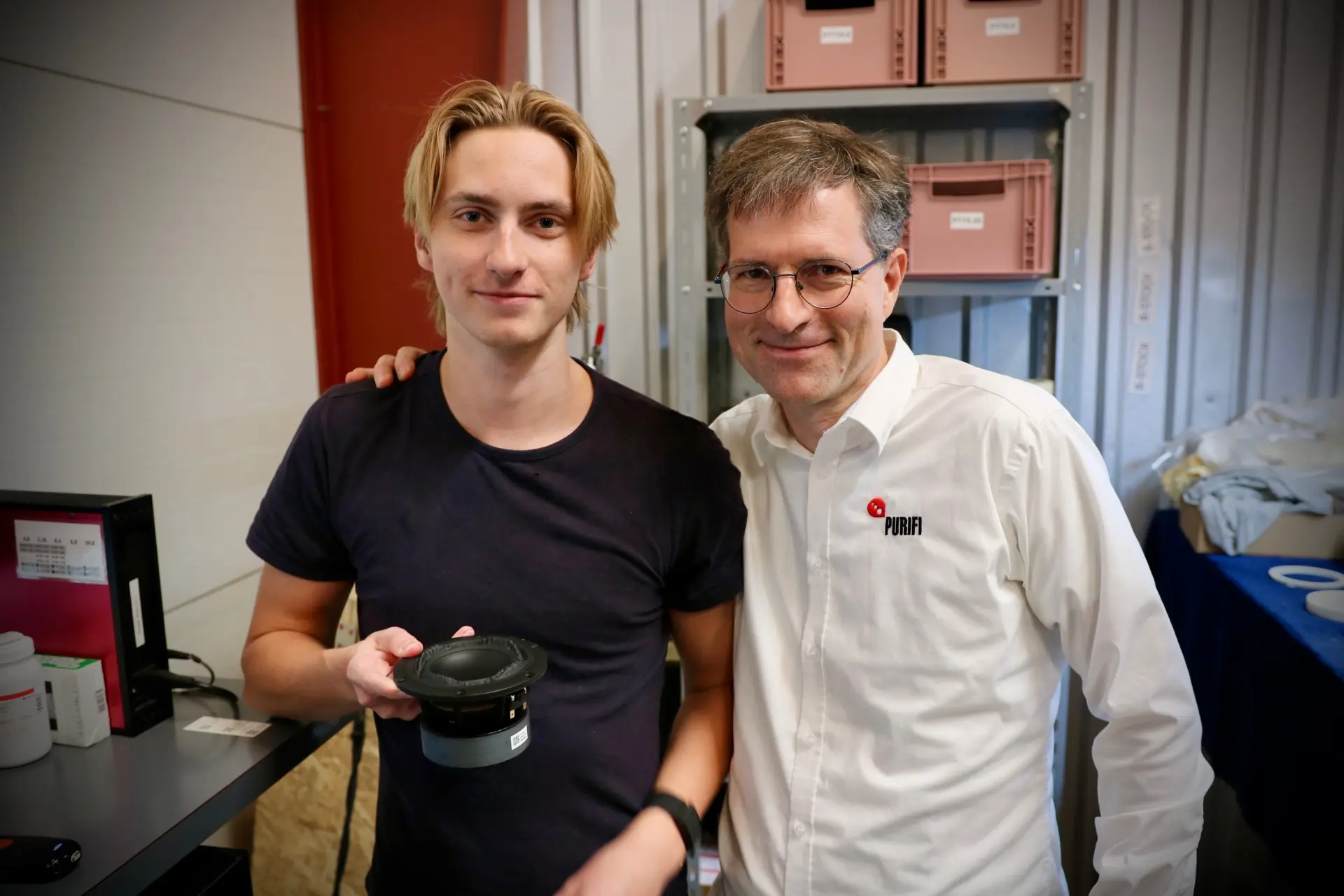
My son was about ten when he watched me and Bruno tearing our hair out over a speaker design — Bruno had more hair back then. He asked why we didn't just buy some good speakers. I had to think about that one: "because the speaker Bruno and I want doesn't exist yet — we have to make it first." He accepted that. Ten years later he's here on a sabbatical, helping build the thing we were arguing about.
That's the objective — the main theme, if we're keeping the metaphor going.
Second Movement: Build the Space you Search in.
Track the real limitation down to the physics and the math — not to what some expert says is hard, but to the actual law. Once you've got a model like that, all the hearsay evaporates — "I tried a Class D and it didn't work" stops being useful information. Without it, you tinker with whatever's known and trusted.
That's not always wrong — some things, a clothespin, a safety pin, tøjklemme, sikkerhedsnål, are battle-tested for a reason and hard to beat after a hundred years of tinkering. But tinkering has its limits, too: bicycle lamps that still work properly here in the salt sprayed, humid Danish winter remain, somehow, unsolved after that same hundred years — nobody went back to first principles, they just kept tinkering.
The loudspeaker is the same age. Until recently, everyone assumed it was just as mature as the clothes pin. We didn't accept that — you heard why, a movement ago. Tinkering alone rarely gets you a real breakthrough.
This isn't the pitch-deck version of first principles. We don't have a rocket factory.
Once you've got the model, you let the computer do the trial and error — fail fast and cheap in simulation before you build anything. We've done this: a force-factor model in 2016 that corrected how we understood how the voice-coil current is interacting with the magnetic gap. Hysteresis distortion nobody had modelled well.
I published a discrete-time Class D loop model in 2005 which explained what the best-practice continuous-time models could not, later expanded with an analysis of Class D ripple aliasing distortion in 2009. Bruno was concurrently working the same problem set, continued the analysis, and picked up the work here at PURIFI. Today it's the universal loop model behind the entire Eigentakt amplifier line — twenty-one years of model development.
But a model alone doesn't optimize anything — it needs a cost function to tell the computer what "good" means. Sounds trivial but it is not. A bad cost function is at least as hard a problem as a bad model, arguably harder. You come in the next morning, look at what the optimizer found, and realize: this isn't what I wanted — but the computer just did exactly what I asked it to. That gap is the whole job. Working out what you actually want, precisely enough to hand to a machine, forces an understanding of the problem that the usual "I'll know it when I hear it" never gives you. In the end our own perception is the judge, and the cost function's entire, uncomfortable purpose is to stand in for that judgment.
Last piece of the space: know what's actually free to move, and what's fixed by physics. The degrees of freedom are usually bigger than you first think. In this industry that space often gets filled with exotic materials — but we keep finding that geometry and topology are the strongest lever, and geometry, unlike exotic materials, is close to free. Look at our drivers — the shapes aren't accidental, they come out of Finite Element Analysis -based shape optimization. Same move on the electrical side: the Eigentakt amplifier's control loop lives in a handful of tiny, cheap passive components. Optimizing those cheap parts against Bruno's expensive loop model is the electrical twin of optimizing a cone or surround's shape.
Third Movement: Trust the experiment — and be ready for it to say no
Feynman put it better than I can: no matter how beautiful the theory, no matter how famous the person who thought of it, if the experiment contradicts it, the theory dies. And: the first principle is that you must not fool yourself — and you're the easiest person to fool.
We've relearned that more than once, but one time is burned in. December 2017: we'd finished the super-linear motor system and expected the measured performance to follow the model. It didn't. Distortion came in far higher than predicted, and it ruined that Christmas. The model was wrong — we'd left out the distortion the surround itself was contributing. That's decomposition doing its job: you don't just note "the measurement disagrees," you break the disagreement down until you find which mechanism is unaccounted for. Once we found it, back to the drawing board, into Comsol, and out the other side came what's now our signature Neutral Surround — the part everyone sees, standing in for a lot of invisible work behind it.
That's falsification at the model level. We run the same logic one level up, on the whole product. Søren runs reliability tests that are, frankly, tedious on purpose — the same fault condition, over and over, hunting for the one combination that exposes a vulnerability. You cannot prove "my amplifier is reliable" — you can only fail to disprove it, and the only conclusive outcome of that kind of test is something blowing up. It's not a pleasant afternoon, but it's the same principle as the Xmas story, aimed at the finished product instead of the physics inside it. That discipline is why, out of a hundred thousand amplifier channels in the field, our return rate is close to zero.
Fourth Movement, and it's the one that makes the other three trustworthy
The evidence has to be honest. Killing a beautiful theory is only as good as the measurement that kills it, and measurement systems have their own limitations — you have to understand them and design them out. We've spent as much engineering effort on measurement as on the products themselves. A couple of man-years went into our own analyzer for motor and suspension model identification — it's now the backbone of our end-of-line test. Our Eigentakt amps measure better than what the industry's gold standard, the APx555B, can resolve directly. We had to invent our own methodology to see past that ceiling.
And the evidence has to survive contact with time. This is where my partner Carsten doesn't compromise — every prototype gets journaled and built to the same precision as a production part, glue quantities recorded to the milligram. Small details — a component choice, a lead length — can be the difference between a working high-power output stage and a dead one. Data like that looks like overkill on the day. Months later, when a pattern finally shows up buried in a dozen prototypes' worth of noise, it's the only reason you can see it at all.
Epilog
Four movements — the objective, the search space, the oracle, the evidence. None of them are exotic on their own. What's rare is playing all four, in order, without skipping the uncomfortable ones. And like any decent symphony,the theme from the opening comes back at the end, changed: my son isn't asking anymore why we don't just buy speakers. Now he's the one wondering what doesn't exist yet.